Monday, March 19, 2012

No. 42: The smart village project starts with government support (March 19, 2012)

Business trend
Two government agencies, the Ministry of Agriculture, Forestry and Fisheries of Japan and the Ministry of the Environment, will jointly start the smart village project in which renewable energy supplies power in rural area. Besides utilizing agricultural water and thinned wood for power generation and heat supply, the project facilitates the installment of equipment for photovoltaic generation and wind generation in the fields and rice paddies that have been abandoned and are no longer cultivated. The project aims to help the rural area realize self-sufficiency of power.

The two agencies will invite public participation for the substantiative experiment to test the cost and combination of generation systems. They will select five locations in the country and assist municipalities financially in their substantiative experiments. They will screen the problems with distribution of power generated by sunlight and water, cost of management, and adjustment of irrigation right in using agricultural water. Rural areas have lots of idle lands for renewable energy generation in addition to thinned wood processable to woody biomass.

Currently, generation by renewable energy accounts for slightly above 1% of all power generation if large-scale hydraulic generation is excluded. The government wishes to increase the share to 3% in three years by utilizing small-scale hydraulic generation and the fields and rice paddies that have been abandoned and are no longer cultivated. For this purpose, it is critical to work out a system that allows the rural area to consume power generated locally.

Saturday, March 17, 2012

No. 41: Japan exerts more energy to develop marine renewable energy (March 18, 2012)

Business trend
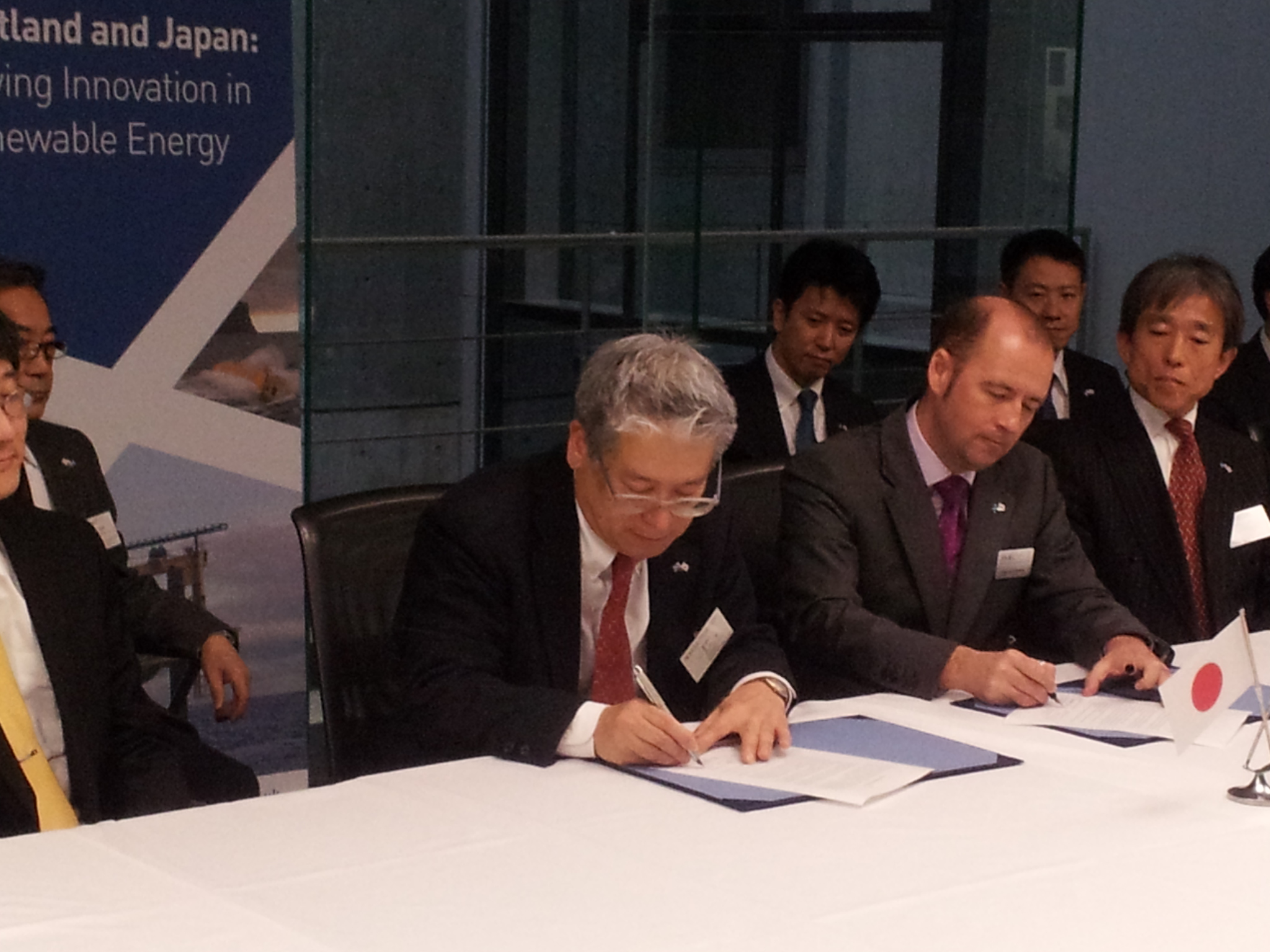
Japan will build two plants for substantiative experiments for the development of marine renewable energy. Ocean Energy Association – Japan (OEA-J), a university-industry collaboration research agency made up of such organizations as Tokyo University and Mitsui Zosen, decided to collaborate with the central and local governments to build two plants for substantiative experiments of ocean energy including wave power and tidal energy. OEA-J exchanged memorandums with the European Marine Energy Centre (EMEC) on March 9. With the support from the EMEC, the OEA-J plans to build the two plants in two years at the earliest. 

Six prefectures are now the candidates for this project. The Japanese government will select a few locations by March next year, taking conditions, such as wave conditions, natural environment including wind velocity and ocean current, and influence over fishery, into consideration. The two plants will allow for plug-in experiments using the underwater cables. To put wave power and tidal energy into practical use, it is necessary to evaluate the profitability by confirming generation efficiency and durability. OCA-J plans to start the project with wave activated power generation and ocean current power generation, and they will be followed by ocean thermal energy conversion. Investment will be one to four billion yen for each plant.

Friday, February 24, 2012

No. 40: Local governments grow more serious about introducing renewable energy (February 25, 2012)

Business trend
Local governments across the country will intensify their efforts to introduce renewable energy with increased investment. Japanese prefectures combined allocated about 52 billion yen for renewable energy in 2012. Making the best use of regional characteristics, every local government will solidify the system of local production for local consumption of energy. Kanagawa Prefecture appropriated 866 million yen to build a large-scale photovoltaic generation plant (mega solar plant) with an output capacity of 2,000 kW. The plant to be operated by the prefecture is scheduled to go into operation in the summer of 2013. Niigata Prefecture will install generating equipment with an investment of 400 million yen in the mega solar it built last October to increase the generation capacity to 2,000 kW coming July.

Surrounded by the sea, Okinawa Prefecture plans to establish a generation system that uses the temperature difference between warm water close to the ocean surface and cold water in deep water. It will start a project in one of its islands. Two prefectures will start research on the utilization of wave force and tidal force. Another prefecture will utilize groundwater for the air-conditioning of greenhouses to grow vegetables and flowers. The system is to pump up groundwater for heat exchange using heat pump. Efforts to develop technology for power storage are also accelerating. Railway Technical Research Institute is developing a technology to store electricity generated by solar light and wind power through the application of the technology used for the linear motor car.  

Thursday, February 23, 2012

No. 39: Canadian Solar comes to Japan (February 24, 2012)

Business trend
Canadian Solar, Canada’s largest solar cell manufacturer, is reportedly having negotiations with several local governments in the Tohoku district to construct a plant. The company will start the construction within the year if it gets favorable and acceptable conditions, and the new plant will go into operation after the spring of 2013. Because mega solar plants (large-scale photovoltaic generation plant) are being planned in the Tohoku district for the recovery from the March 11 disaster, it will build a base to get involved in the photovoltaic generation business. Canadian Solar in the world's third or fourth largest solar cell manufacturer in volume.  

The company will import solar cells from its plant in China and assemble them to build photovoltaic panels in Japan. The annual production capacity is estimated at 150,000 kW. The investment is estimated at several billion yen. Because the system to purchase all amount of renewable energy will start in July, the Tohoku district attracts wide attention both at home and abroad. Showa Shell is reportedly considering building a solar cell plant in the Tohoku district. It seems likely that the Tohoku district will become a cluster of companies involved in renewable energy business.   

Sunday, February 19, 2012

No. 38: Introducing a photovoltaic generation system to schools (February 20, 2012)

Business trend
A company in Nagano Prefecture will start to install a photovoltaic generation system in local schools. With the support form the prefecture and an NPO, Sunjunior that specializes in the photovoltaic generation business plans to install the system in five local public schools this spring, and increase the number of schools to 700 in five years. The company will install a photovoltaic generation system with an output of 100 kW, which is equivalent to the output for 25 households, on the roof of school building. The system will come with an emergency power source and LED lighting to provide a gymnasium with the function as an evacuation center in a time of disaster.

It costs about 40 million yen to install the system. Sunjunior will bear part of the cost, and the remaining expenses will be covered by the investment from local companies, local residents, and graduates. Generated power will be sold to electric power companies, and investors will collect their investments from the revenue of selling electricity. The company is working on the details of investment with the NPO, Renewable Energy Shinshu-net, and they wish the investment to be collected in 20 years. While running the system, the company will improve the generation efficiency and operation method to establish the optimal system. With the growing concern over renewable energy, grass-roots projects are expected to spread nationwide in Japan.

Saturday, February 18, 2012

No. 37: Small-size generators are coming one after another (2/2) (February 19, 2012)

Technology
The small-size generation system utilizing sunlight increases presence, as does the small-size hydraulic power unit. Sinfonia Technology will introduce an integrated natural energy generation system with an output of 20 kW. The system is made up of a solar panel, small-size windmill, and waterwheel, each of which has an output between 5-10 kW. It also comes with a lead storage battery with a storage capacity of 10 kW. The new system will be priced at 40 million yen. The company plans to market it to isolated islands both at home and abroad with undeveloped infrastructure and municipalities as an emergency power source.

HitachiHigh-Technologies has already started to market its small-size generationsystem that stores power in a storage battery to isolated islands in Indonesia. The system runs a water purification system by dint of photovoltaic generation and stores the generated power in a storage battery. With the special measure law to purchase renewable energy at hand in Japan, heavy electric machinery companies are intensifying their efforts to introduce small-size generation units. Because there are many areas that do not have a well-developed power network in Asia, they are serious about developing these markets, too.  

Friday, February 17, 2012

No. 36: Small-size generators are coming one after another (1/2) (February 18, 2012)

Technology
Japanese heavy electric machinery makers are busily occupied in launching small-size generators in preparation for the special measure law to purchase renewable energy scheduled for enactment on July 1, 2012. Toshiba developed a small-size hydraulicpower unit with a maximum output of 1 kW. It weighs about 50 kg and the diameter of the waterwheel is 0.7 m. It can generate where the water depth is more than 1 m and a drop between the upstream and downstream is 0.3-1.5 m. It is easily installable because what is needed is to bridge equipment loaded with waterwheel between the two banks. The output of 1 kW is enough to supply power to 25 fluorescent lamps or 100 LEDs. The unit is scheduled to be priced at 600,000 yen. The company plans to market it to municipalities that manage rivers and irrigation channels. It will be possible to recoup the investment in 7-8 years.

MitsubishiElectric Plant Engineering, a wholly-owned subsidiary of Mitsubishi Electric, developed a small-size hydraulic power unit with a maximum output of 9.9 kW. It weighs 43 kg that is one third of the existing model. It can generate even if the drop is 50 cm. It is a package product coming with a waterwheel and a generator, thus no civil work is necessary. In addition, the structure is hardly affected by sludge and sand contained in water because the waterwheel does not have axle bearing. The company wishes the unit to be used for power sources for plant factory, plastic greenhouse culture, and emergency electricity besides for charging electric vehicles.