Wednesday, April 25, 2012

No. 47: The purchase price of electricity generated by photovoltaic generation is preliminarily set at 42 yen per kW (April 25, 2012)

Business trend
The Japanese government started making arrangements with authorities concerned to set the purchase price of electricity generated by photovoltaic generation at 42 yen per kW including tax. The system that asks electric power companies to purchase all electricity generated by such renewable energies as sunlight and wind at a fixed price will be enacted coming July. The system is expected to remain effective for about 20 years.

Some authorities insisted that the purchase price should be less than 40 yen, but the committee on the purchase of renewable energy gave higher priority to stimulating generation by renewable energy. The preliminary price will be submitted to the meeting of the committee. The Minister of Economy, Trade and Industry will give the final approval to the decision of the committee.
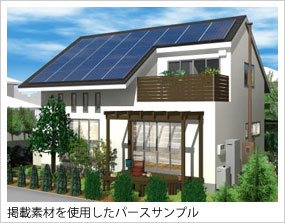
 Photovoltaic generation on the rooftop of a house

Sunday, April 22, 2012

No. 46: Fund raising for the construction of mega solar power plants grows more active (April 23, 2012)

Business trend
The move to raise funds from investors for the investment in mega solar power plant is growing more active toward coming July when the special measures to stimulate the renewable energy business are enacted. Orix, one of Japan’s leading financial service companies, will create an investment fund of 30 billion yen, and it will be followed by other companies.

As the first step, Orix will create a fund of 10 billion yen by the summer of 2013 and construct 5-10 mega solar power plants. All stocks of the fund will be sold to institutional investors when these plants go into operation, and electricity generated by photovoltaic generation will be sold to the local electric power company. The investors will receive dividends of the fund that is expected to be 5%. Orix will create another two funds of the same kind by the summer of 2015. That is, the company will construct 5-10 mega solar power plants that have a combined output of 100,000 kW enough to supply electricity to 30,000 households in three years.

Tokyo Marine Asset Management will create a fund to raise investment for the construction of 10 mega solar plants across the country in alliance with Mitsui and Co. The output is scheduled to be 1,000-2,000 kW each. Toyota Tsusho and Eurus Energy in which Tokyo Electric Power invested will invest 40-50 billion yen to construct three 100,000 kW class mega solar power plants. The financing method will be the project finance that gets finance from the bank on security of the revenue from selling electricity. The two companies plan to create a fund and collect capital from institutional investors in the future.

Generation by renewable energy accounts only for 1% of total generation in Japan, but the moves to construct the mega solar power plant is expected to grow against a backdrop of the increasing sentiment of anti-nuclear power generation.   

 The large-scale mega solar power plant outside Osaka

Wednesday, April 18, 2012

No. 45: Japanese companies grow energetic on the geothermal generation (April 18, 2012)

Technology
The feed-in tariff program to purchase all power generated by renewable energy will be enacted staring in July in Japan. Leading companies are busy with preparing to develop technology and construct system in time for the launch of the program. Toshiba developed a highly efficient geothermal generation technology that reuses waste energy used geothermal generation and increases output by 30%. This technology can decrease generation cost by 10-20% in the long run. Contrary to the conventional system that mostly uses only one turbine, Toshiba’s new system runs the first turbine using steam higher than 150 degrees centigrade collected several hundreds meters below the ground surface and the second turbine using waste heat that is below 150 degrees centigrade.

The initial cost will be higher for the additional functions, but the increased part of investment can be collected in 10-15 years because output is greater. And the generation cost will be 20-30% lower after the return of investment. Geothermal generation has the potential to generate 24 million kW that is about 10% of Japan’s total generation capacity, but the business has been slow because locations suitable for geothermal generation are mostly inside the national park and because the regulation of development is rather strict. Deregulation scheduled to start coming July stimulates technological progress of the Japanese companies concerned.

In the world geothermal generation market, Toshiba, Mitsubishi Heavy, and Fuji Electric are the three leading companies, and they have a combined share of 70% in the world market. The move to develop geothermal generation is growing widespread in the U.S., Asia, and Africa. Mitsubishi Heavy has been conducting feasible study of geothermal generation in East Africa including Djibouti in alliance with Marubeni since last autumn. Fuji Electric established a company in India to sell industrial products in Asia.  

A geothermal generation plant in the Tohoku district    

The largest geothermal generation plant in Japan 
    

Monday, March 26, 2012

No. 44: The nation’s largest geothermal plant is planned (March 26, 2012)

Business trend
Three companies of Idemitsu Kosan, INPEX, and Mitsubishi Materials drew a plan to build the nation’s largest geothermal plant in Fukushima Prefecture, responding to the conditional deregulation of excavation inside national and quasi-national parks published by the Ministry of the Environment. The new geothermal plant is scheduled to start operation toward 2020. The scheduled output is 270,000 kW that is a quarter of the output of a nuclear power plant. Made up of several plants with an output of 50,000 kW each, the new plant will supply power to 70,000 households. Total investment will be 100 billion yen. Japan Petroleum Exploration and Mitsui Oil Exploration will supposedly joint the three companies, and the project will supposedly be carried out by a total of nine companies. The companies involved will hold a presentation meeting in April. They will give the highest priority to local employment for public works like road construction and work out measures for the attraction of tourists.

Japan has the world’s third largest geothermal resources with about 24,000,000 kW following the U.S. and Indonesia, but it currently has an output of about 540,000 kW because 80% of resources are inside its national and quasi-national parks. The new plant with an output of 270,000 kW will surpass the Hachobaru Plant operated by Kyusyu Electric Power that is currently the largest geothermal plant in Japan. According to the government committee working on power generation costs, geothermal generation costs 9-11 yen per kW that is almost the same level of coal fired power generation. Toshiba, Mitsubishi Heavy, and Fuji Electric have a combined share of 70% in the geothermal plant market in the world. Intensifying competition will inevitably accelerate technological innovation of all companies involved.   

Currently, Japan's largest geothermal plant in Kyushu that has an output of 110,000 kW. The new geothermal plant planned by Idemitsu Kosan and others will have an output of 270,000 kW.       

Wednesday, March 21, 2012

No. 43: A floating wind and tidal power plant that combines windmills and waterwheels (March 22, 2012)

Technology
Offshore wind power generation attracts wide attention because it is free from such restrictions as noise problem and scenery destruction, in addition to being very economical. Therefore, the most economical and most efficient generation seems to be the power plant that makes the best use of wind and tidal wave generation systems. Mitsui Ocean Development and Engineering (MODEC) developed a floating generation system made up of wind generation and tidal power generation. The system can increase generation efficiency and utilized capacity, while halving the generation cost by combining the optimal revolutions and torques of windmills and waterwheels. The output of the system is 1 MW.

The system set up windmills on the sea and waterwheels under the sea to generate power simultaneously by virtue of wind and tidal power. It employs vertical axis windmills instead of horizontal axis windmills for wind generation because the former has four times higher output per area than the latter and because the former has higher stability than the latter thanks to its low gravity point. The windmills are supported by a simple floating structure and anchor chains, and neither civil work nor special ship is required.

It employs the lift type wings of high-revolution low-torque for the windmill and the drag type wings of low-revolution high-torque wings for waterwheels. The optimal combination of these wings and the integrated use together with the generator decreases opportunity loss and realizes high output. The standard ocean generation has 20-30% utilized capacity, while the new system has 30-50% utilized capacity. The company plans to commercialize the system toward 2014 as a small-scale dispersion type power source for isolated islands. 


Monday, March 19, 2012

No. 42: The smart village project starts with government support (March 19, 2012)

Business trend
Two government agencies, the Ministry of Agriculture, Forestry and Fisheries of Japan and the Ministry of the Environment, will jointly start the smart village project in which renewable energy supplies power in rural area. Besides utilizing agricultural water and thinned wood for power generation and heat supply, the project facilitates the installment of equipment for photovoltaic generation and wind generation in the fields and rice paddies that have been abandoned and are no longer cultivated. The project aims to help the rural area realize self-sufficiency of power.

The two agencies will invite public participation for the substantiative experiment to test the cost and combination of generation systems. They will select five locations in the country and assist municipalities financially in their substantiative experiments. They will screen the problems with distribution of power generated by sunlight and water, cost of management, and adjustment of irrigation right in using agricultural water. Rural areas have lots of idle lands for renewable energy generation in addition to thinned wood processable to woody biomass.

Currently, generation by renewable energy accounts for slightly above 1% of all power generation if large-scale hydraulic generation is excluded. The government wishes to increase the share to 3% in three years by utilizing small-scale hydraulic generation and the fields and rice paddies that have been abandoned and are no longer cultivated. For this purpose, it is critical to work out a system that allows the rural area to consume power generated locally.

Saturday, March 17, 2012

No. 41: Japan exerts more energy to develop marine renewable energy (March 18, 2012)

Business trend
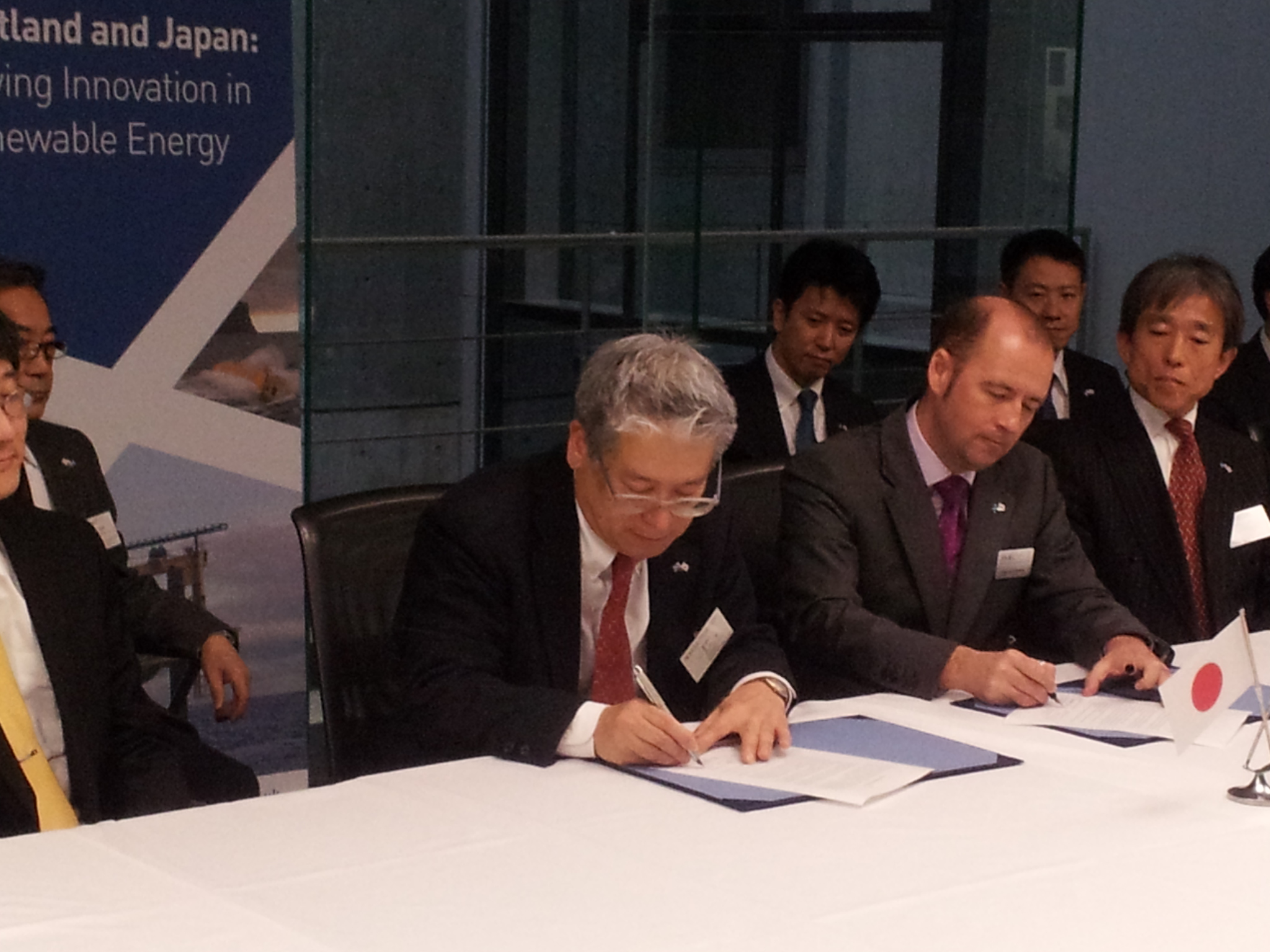
Japan will build two plants for substantiative experiments for the development of marine renewable energy. Ocean Energy Association – Japan (OEA-J), a university-industry collaboration research agency made up of such organizations as Tokyo University and Mitsui Zosen, decided to collaborate with the central and local governments to build two plants for substantiative experiments of ocean energy including wave power and tidal energy. OEA-J exchanged memorandums with the European Marine Energy Centre (EMEC) on March 9. With the support from the EMEC, the OEA-J plans to build the two plants in two years at the earliest. 

Six prefectures are now the candidates for this project. The Japanese government will select a few locations by March next year, taking conditions, such as wave conditions, natural environment including wind velocity and ocean current, and influence over fishery, into consideration. The two plants will allow for plug-in experiments using the underwater cables. To put wave power and tidal energy into practical use, it is necessary to evaluate the profitability by confirming generation efficiency and durability. OCA-J plans to start the project with wave activated power generation and ocean current power generation, and they will be followed by ocean thermal energy conversion. Investment will be one to four billion yen for each plant.